
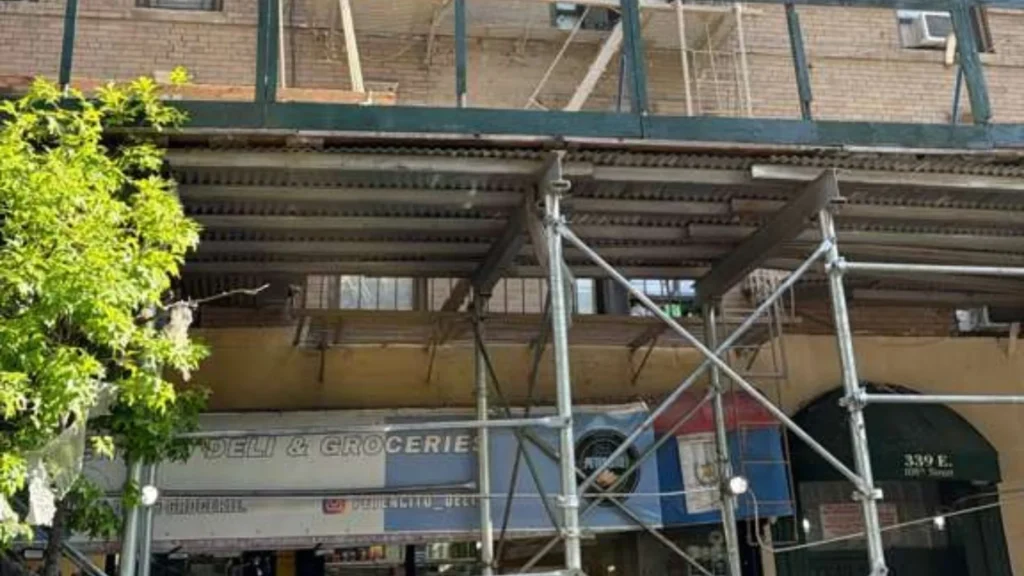
A sidewalk shed (also called a sidewalk bridge) is a temporary structure that protects pedestrians from falling debris during construction, demolition, or facade work.
We design, file, install, and maintain sidewalk sheds across Manhattan, Brooklyn, Queens, and the Bronx, plus Hudson, Bergen, and Essex Counties in New Jersey, with 24/7 emergency response.
Generally required above 40 ft for applicable construction and facade work in NYC (25 ft for applicable demolition work). We handle the DOB filing. Emergency response is available 24/7.
Yes, in most cases. Under NYC Building Code §3307.6.2
There is no statewide height trigger like NYC’s. New Jersey handles pedestrian protection through the Uniform Construction Code (N.J.A.C. 5:23, nj.gov/dca/codes), administered by the NJ Department of Community Affairs and enforced locally.
Whether your project needs overhead protection is decided by your municipal construction official during permitting, not by a fixed number in the state code.
A sidewalk shed is a temporary structure built over a public sidewalk. It protects people below from falling tools, debris, and materials while work happens above.
It also goes by:
A standard shed includes:
What a sidewalk shed is not
A sidewalk shed has nothing to do with a residential storage or garden shed. It is not governed by setback rules, lot coverage limits, or accessory structure codes. It is a code-mandated pedestrian protection system, inspected on a set schedule and removed once the work above it is finished.
The requirement depends on the type of work, building height, site conditions, and whether the project is in NYC or New Jersey.
Features | New York City | New Jersey |
Height trigger | 40 ft for new construction, enlargements, or facade work; 25 ft for demolition | No fixed statewide height rule |
Who decides | NYC Department of Buildings (DOB), per Building Code §3307.6.2 | Local municipal construction official, per N.J.A.C. 5:23 |
2026 update | For qualifying facade-maintenance and repair situations, required shed coverage generally cannot extend more than 40 ft from the building unless the Commissioner requires additional coverage because of a unique hazard. | No comparable statewide cap; coverage is set locally |
Can inspections trigger it? | Yes, when unsafe conditions identified through inspection require protective work; an inspection alone does not automatically require a shed. | Yes, evaluated case by case during permitting |
NYC gives you a number. New Jersey gives you a phone call to your local construction office. If a New Jersey contractor tells you there is no fixed trigger height, that is accurate, not an evasion.
If your requirement came from an inspection report rather than a planned construction project, the required protective measures and filing process depend on the condition identified and the scope of work.
Not sure if your building needs one?
We handle the filing process and coordinate the required approvals so you know exactly who needs to submit, stamp, and approve your shed plans.
New York
New Jersey
New Jersey generally separates construction-code review from local zoning or land-use approval when both are required. Exact applications, processes, and sequencing vary by municipality:
In NYC, required sidewalk-shed lighting must be installed by a licensed electrician.
Whether you’re planning ahead or already facing a DOB notice, we handle design, filing, installation, and maintenance end to end, across NYC and northern NJ.
Free assessment. Most surveys are scheduled within 48 hours.
Already have a shed up, or need someone on site now? Call our 24/7 emergency line, (732) 555-0198.
Average emergency arrival: 2 hours.
For applicable new construction, enlargements, or facade work, the NYC trigger is generally above 40 feet, subject to the conditions in Building Code §3307.6.2. Full or partial exterior demolition has a 25-foot trigger under the applicable conditions.
No. New Jersey does not have a statewide height threshold equivalent to NYC's 40-foot sidewalk-shed trigger. Requirements are governed by the Uniform Construction Code and applied through the local construction-code enforcement process.
A Registered General Contractor. Only certain contractors hold this DOB registration, and the shed permit runs through that credential specifically.
Sometimes. If the shed matches a Board of Standards and Appeals pre-approved design, an unlicensed applicant can file without a Registered Design Professional's stamp. Non-standard sites or loads still require a stamped design.
Yes, in NYC. A separate NYC DOT Building Operation Permit may also be required if the shed extends into the street.
Licensed scaffolding rental, sidewalk shed installation, and 24/7 emergency site protection across all five NYC boroughs and Northern New Jersey.