
Temporary construction fence rental and installation for New Jersey and New York City. New Jersey Sidewalk Shed & Scaffolding provides 8-foot solid fencing, gates, viewing panels, site surveys, installation, and removal for construction and demolition sites across Hudson and Essex County, NJ, and all five NYC boroughs.
In New York City, every new construction and full demolition site needs a fence meeting BC 3307.7, regardless of the building’s height: at least 8 feet, solid for its full length, with gates and non-frangible viewing panels where required.
On qualifying sites, a fence can legally replace a sidewalk shed entirely under BC 3307.3.2, a determination that comes down to a site measurement, not a guess. In New Jersey, requirements are set by the local construction official under the state’s Uniform Construction Code, and they vary by municipality.
A breached or downed site fence is a live public-safety exposure, not a maintenance item that can wait. That’s why our emergency response averages a 2-hour arrival, 24/7.
Building height doesn’t decide whether you need a fence. Every new construction and full demolition site in New York City must be enclosed with a fence that meets BC 3307.7, whether the building is three stories or thirty. The same requirement extends to excavations and any grade-level condition that could put pedestrians at risk before a structure even breaks ground.
This is where most sites get caught out: the fence isn’t optional pending a smaller project, and it isn’t something you install after the first inspection flags it. It has to be up before work commences, a requirement covered in detail under Rental, Installation and Duration below.
New Jersey doesn’t run on the NYC Building Code, so none of the BC 3307 specifications above apply across the river. Instead, fencing requirements for construction and demolition sites are set at the municipal level under New Jersey’s Uniform Construction Code (UCC), and the local construction official has discretion over what a given site needs.
In practice, that means requirements can shift block to block depending on which municipality you’re building in. A few things that generally hold true across Hudson and Essex County:
Because the specifics are set locally, the right first step for a New Jersey job is a call to confirm what your specific municipality requires, not an assumption carried over from a New York job, and not a generic answer from a company that doesn’t work the Hudson-Essex corridor regularly. We do, and that call is part of every NJ site survey we run.
This is the question that actually decides the budget on a lot of jobs, and it’s one the national fence-rental sites can’t answer, because it isn’t a fencing question. It’s a code question.
Under BC 3307.3.2, a fence can be used in lieu of a sidewalk shed when a structure higher than 40 feet is being constructed, or higher than 25 feet is being demolished, and the horizontal distance from the structure to the inside edge of the sidewalk falls between one half and three quarters of the building’s height.
In plain terms: if your building sits far enough back from the sidewalk relative to its height, the code treats a fence as sufficient pedestrian protection, and you may not need the shed at all.
That’s not a small distinction. A sidewalk shed runs for the life of the project and covers the sidewalk itself. A fence encloses the site perimeter. Getting this determination right, before you price the job, is the difference between renting one structure and renting two.
| Sidewalk Shed | Fence | |
|---|---|---|
| Governs | BC 3307.6 | BC 3307.7 |
| Protects | The sidewalk below | The site perimeter |
| Can it replace the other? | Required below the height/distance threshold | Permitted above it, per BC 3307.3.2 |
| Typical trigger | Close setback relative to height | Wider setback relative to height |
We won’t tell you over the phone that your specific site qualifies, because the geometry has to be measured, not guessed. That measurement is exactly what a site survey is for, and it’s the fastest way to find out whether you’re paying for one structure or two.
Once a fence is required, BC 3307.7 spells out exactly what it has to be, and this is where otherwise well-run sites tend to pick up violations, usually on the gate or the panel, not the fence itself.
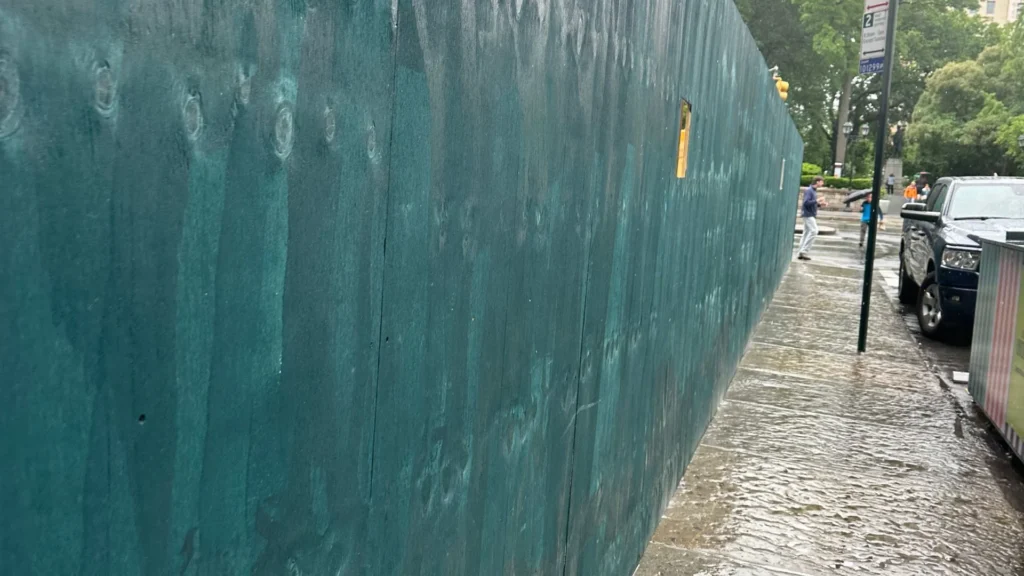
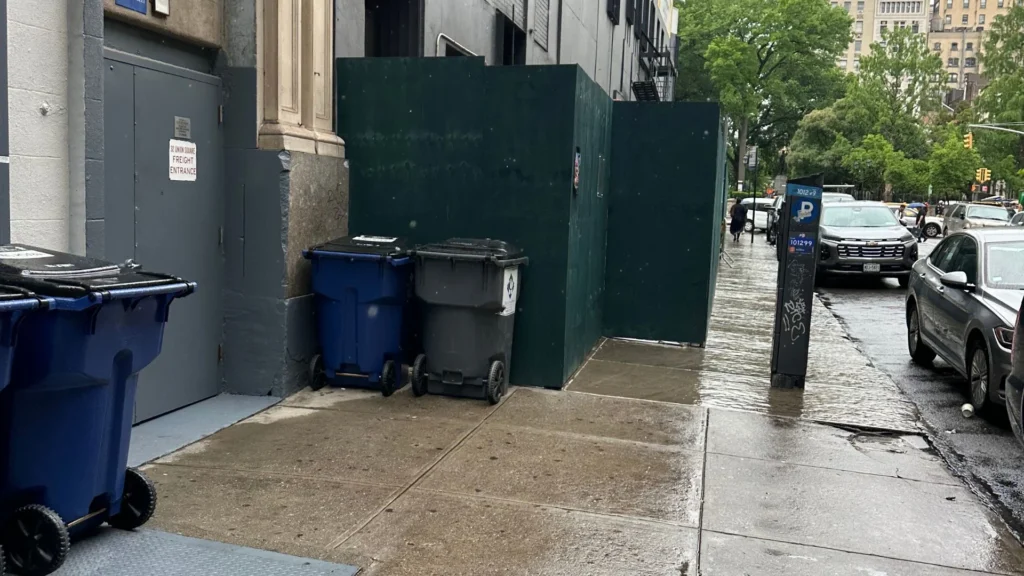
At least 8 feet high, built of wood or other suitable material, solid for its entire length. "Solid for its entire length" means gaps aren't a design choice; they're a compliance failure, with two specific exceptions below.
Openings are permitted only where solid sliding or in-swinging gates are needed for the work itself, not for general convenience access.
Where a viewing panel is included, it has to be blocked with plexiglass or an equivalent non-frangible material, so the opening doesn't become a hazard in its own right.
Under Local Law 47 (effective August 15, 2025), solid fences on new construction or full demolition sites must be hunter green, metallic gray, or white, with no exceptions for facade-matching on those project types. Existing buildings doing partial work get more latitude and can match the facade, trim, cornice, or a visible sloped roof. Where a fence and a sidewalk shed share a site, both must be the same color, applied uniformly across every publicly visible part, gates included. Fences filed before August 15, 2025 are grandfathered under the old rule, though a repaint now can bring them current voluntarily. One detail that surprises a lot of owners, zoning regulations do not apply to temporary construction fence projects. It's a filing shortcut that a panel-inventory company won't know to mention. Where scaffolding and fencing meet on the same job, which is common on a demolition or new-build site, we install both, so scaffold fencing at a hoist or material zone is coordinated with the site fence rather than treated as two separate vendors' problems.
Under Local Law 47 (effective August 15, 2025), solid fences on new construction or full demolition sites must be hunter green, metallic gray, or white, with no exceptions for facade-matching on those project types. Existing buildings doing partial work get more latitude and can match the facade, trim, cornice, or a visible sloped roof. Where a fence and a sidewalk shed share a site, both must be the same color, applied uniformly across every publicly visible part, gates included. Fences filed before August 15, 2025 are grandfathered under the old rule, though a repaint now can bring them current voluntarily. One detail that surprises a lot of owners, zoning regulations do not apply to temporary construction fence projects. It's a filing shortcut that a panel-inventory company won't know to mention. Where scaffolding and fencing meet on the same job, which is common on a demolition or new-build site, we install both, so scaffold fencing at a hoist or material zone is coordinated with the site fence rather than treated as two separate vendors' problems.
If you came to this page from a sidewalk shed job, this is probably the section that matters.
Footings and scaffold bases that extend past the curb need physical separation from traffic and pedestrians, not just a DOT permit. Where work or storage next to a shed isn’t already contained inside a fenced site, applicable code provisions may require either a chain-link fence at least 8 feet high, or a solid barrier at least 32 inches high topped with chain link to 8 feet (hoist and chute zones follow separate rules).
That’s where barrier and fencing work overlap: a concrete barrier base with chain link above it can function as a combined separation system rather than two unrelated site products. Full fence specifications live on temporary fencing; this page covers the barrier half of that combination.
Separating the work zone from the storage area also matters: vehicle access, pedestrian movement, active work, and material storage should each have a defined boundary.
We had a demo site in Jersey City where the fencing requirement changed mid-permit. They caught it before the inspector did and had the gate reconfigured within the day.
Island, Manhattan, and Queens) and across Hudson and Essex County, New Jersey.
Site conditions and filing requirements shift at the state line, which is exactly why the New Jersey section above stands apart from the New York City code citations elsewhere on this page. Wherever the job sits, the fence has to be in the ground before the crew shows up, and that’s what a site survey is for.
Related services: Sidewalk Shed Rental · Scaffolding · Jersey Barrier Rental
Fence, shed, or both, the geometry decides it, and we measure it for free.
At least 8 feet, and solid for its entire length, except for gate openings required for the work and viewing panels fitted with plexiglass or equivalent non-frangible material. This comes directly from BC 3307.7.
Yes. Every new construction and full demolition site must be enclosed with a compliant fence under BC 3307.7, regardless of the building's height.
Yes, under BC 3307.3.2, when a structure is taller than 40 feet (new construction) or 25 feet (demolition) and set back far enough from the sidewalk relative to its height. A site survey confirms whether a specific project qualifies.
Yes. As of August 15, 2025, under Local Law 47, solid fences on new construction and full demolition sites must be hunter green, metallic gray, or white. Existing buildings doing partial work have more color flexibility, and a fence sharing a site with a sidewalk shed must match the shed's color.
Once the site is filled and graded with public hazards removed, or the facade is fully enclosed with doors, windows, and exterior work complete aside from incidental finishing work.
In specific situations only: certain small buildings set back from the sidewalk, and sites where work has been discontinued for two or more years and certified clear of hazards by a registered design professional.
Construction fence requirements are handled separately from the site's underlying zoning requirements. For a specific NYC project, the applicable DOB filing and site conditions should be confirmed before installation.
Where a fence and a sidewalk shed exist on the same site, both must be inspected daily, with inspection records kept on site.
There's no statewide spec like NYC's BC 3307. Requirements are set by the local construction official under the Uniform Construction Code and vary by municipality. Most Hudson and Essex County towns require perimeter fencing on any open excavation or exposed demolition site, but height, material, and setback rules should be confirmed with your specific municipality before you budget the job.
Licensed scaffolding rental, sidewalk shed installation, and 24/7 emergency site protection across all five NYC boroughs and Northern New Jersey.